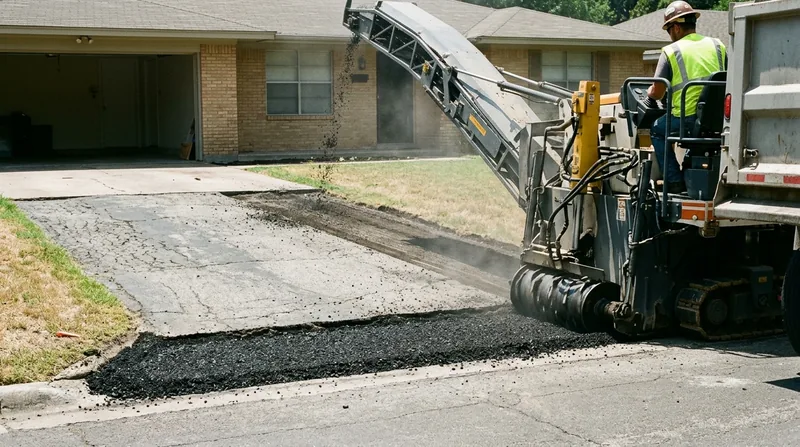




Asphalt Resurfacing & Overlay in Fort Worth is the smart move when your driveway has a solid base but a heat-cracked, weathered surface. Fort Worth's extreme summer heat, clay soil movement, and spring storms crack asphalt from the top down, and when you see a network of fine cracks spreading across the surface, milling and overlaying stops the damage before it reaches the base. We mill the worn top layer, apply tack coat, and lay a new binder and surface course pitched to shed water off the flat ground that dominates much of the city. This process costs less than full replacement, extends the life of your driveway by 10 to 15 years, and restores the look and function without the excavation and base work a new driveway demands.
Why Asphalt Resurfacing Matters in Fort Worth's Heat and Clay
Fort Worth sits on thin rocky clay over limestone, and the summers regularly push above 100 degrees. That combination works hard on asphalt. Heat softens the binder, and the clay underneath swells and shrinks with rain and drought, opening cracks at the edges and working at the garage apron. Once a driveway shows alligator cracking or a web of heat cracks across thirty to forty percent of the surface, patching throws money away. A resurfacing overlay addresses the problem before the base fails, and it works best when the underlying structure is still sound.
- Heat cracks and alligator patterns signal that the surface layer has lost flexibility and must be replaced.
- Milling removes the damaged layer without touching the base, preserving what is working underneath.
- A new surface course bonds to the milled layer and sheds Fort Worth's spring storms and summer heat without rutting.
- Overlay costs roughly half what full replacement costs, and it works when the base is still structurally sound.
- Proper pitch and drainage keep water from pooling on the flat ground common in Arlington Heights, Fairmount, and the newer subdivisions pushing toward Benbrook.
Understanding when your driveway needs resurfacing versus patching or full replacement is the difference between a smart investment and money wasted on temporary fixes.
Key info: Fort Worth's clay soil moves with drought and rain, opening cracks at the edges of driveways and working at the garage apron where the surface meets the grade. Resurfacing seals those cracks and restores pitch to move water away from the foundation. If the base is still solid, overlay is the right call.
For more detail on when to repair versus resurface, see our driveway repair page.
How We Mill and Overlay: The Fort Worth Process
Resurfacing starts with milling. We remove the top 1.5 to 2 inches of damaged asphalt with a drum mill, which grinds the surface to a uniform depth and leaves a clean, roughened layer for the new asphalt to bond to. The milled material can be recycled or hauled away. Once the surface is milled, we apply tack coat, a sticky adhesive layer that glues the new asphalt to the milled base. Then we lay the new binder course and surface course, compacting each layer to the proper density so it will stand up to Fort Worth heat and traffic.
- We measure the driveway and mill the top layer to uniform depth, removing all loose or damaged asphalt.
- The milled surface is cleaned of dust and debris before tack coat is applied to ensure a strong bond.
- We lay hot mix asphalt in two courses, binder and surface, compacting each to proper density.
- The finished surface is pitched to shed water and is ready for light traffic after 24 to 48 hours.
- Full cure takes 30 to 60 days, and we recommend no sealcoating for the first six to twelve months while the material hardens.
The quality of the base preparation and compaction is what keeps the overlay from cracking prematurely in Fort Worth heat.
Example: A driveway in North Richland Hills with a solid 4-inch base and a cracked 2-inch surface layer is a perfect overlay candidate. We mill the top 2 inches, lay new binder and surface, and the driveway functions as new for a fraction of the cost of full replacement. The existing base stays in place and continues to carry the load.
Learn more about the milling process and material recycling.
Resurfacing Methods and When Each Works Best
| Approach | Description | Best for |
|---|---|---|
| Mill and Overlay | Remove top layer, apply tack coat, lay new binder and surface course. | Solid base with heat cracking, alligator cracking, or surface wear across 20 to 40 percent of the driveway. |
| Thin Overlay (1 to 1.5 inches) | Apply a thin new surface layer without milling, used only when the existing surface is smooth and stable. | Minimal wear, slight fading, or a driveway that needs refreshing but shows no structural cracking. |
| Full-Depth Replacement | Remove all asphalt and base, prepare new base, and lay full thickness of new asphalt. | Base failure, extensive subsurface damage, or alligator cracking covering more than 40 percent of the surface. |
| Patching Before Overlay | Fill potholes and isolated failures with asphalt before milling and overlaying the whole surface. | A few localized failures on a driveway that is otherwise a good overlay candidate. |
Most Fort Worth driveways with solid bases and heat-cracked surfaces fall into the mill and overlay category. The choice depends on the extent of the damage and the condition of the base, which we assess on site during a free estimate.
Asphalt Resurfacing & Overlay Cost in Fort Worth: What to Expect
Resurfacing costs start at around $4 per square foot for a straightforward mill and overlay on a standard residential driveway. A typical 1,000-square-foot driveway runs from $4,000 to $5,500, depending on the condition of the base, the complexity of the drainage, and site access. Driveways with steep pitches, narrow lots, or poor drainage may cost more because they require extra base work or grading before the overlay is laid. Longer jobs or commercial parking lots are quoted on site based on measurement and material specifications.
The main cost factors are the size of the driveway, the thickness of the new overlay, the condition of the milled surface, and whether any base repair or grading is needed. A driveway in Benbrook with a long apron and poor drainage will cost more than a short, flat drive in North Richland Hills. Heat, traffic, and soil type also affect how long the overlay will hold. Getting two or three written estimates with tonnage and thickness specified is the only way to compare apples to apples.
Key info: Every estimate should include the square footage, the depth of milling, the tonnage of new asphalt, and the thickness of the binder and surface courses. If an estimate is missing tonnage or thickness, you cannot compare it fairly to another quote. We provide written estimates with all specifications included.
For a full pricing breakdown and examples, visit our pricing page.
Asphalt Resurfacing & Overlay Near Me: What Fort Worth Homeowners Should Know
Choosing a contractor for resurfacing is as important as choosing the method. A good contractor gives you a written estimate with tonnage and thickness, explains why overlay is the right choice (or why it is not), and walks you through the timeline and curing process. Many homeowners confuse asphalt paving with other trades. Verify that the contractor is fully insured and can provide proof of coverage. Check local permitting requirements with your city or HOA, because driveway aprons, curb cuts, and extensions are regulated differently across Fort Worth, Arlington, Haltom City, and other municipalities.
- Ask for a written estimate that includes square footage, milling depth, tonnage of new asphalt, and course thickness.
- Check that the contractor is fully insured and ask to see proof of coverage.
- Get two or three estimates and compare the tonnage and thickness, not just the price.
- Verify local permitting requirements with your city building department or HOA before work begins.
- Ask about the timeline, curing time, and whether the driveway will be ready for traffic within 24 to 48 hours.
- Avoid contractors who offer unsolicited door-to-door estimates, demand large cash deposits, or have no written contract.
A local contractor with a local address and local plates is a stronger signal of reliability than a traveling crew, because the historic fraud in driveway paving is the itinerant pitch. Honest guidance and a clear explanation of why your driveway needs resurfacing, patching, or replacement is the differentiator.
Call us at (817) 529-9224 for a free, no-obligation estimate. We measure on site, provide written specifications, and explain the work in plain terms. Contact us to schedule your free estimate.
Asphalt Resurfacing & Overlay in Fort Worth: Pricing Guide
| Service | Price | Details |
|---|---|---|
| Mill and Overlay, Standard Residential | Starting at $4/sq ft | Includes milling, tack coat, binder and surface course on solid base, typical 1,000 sq ft driveway $4,000 to $5,500 |
| Mill and Overlay with Base Repair | Starting at $5/sq ft | Includes spot base repairs, grading, or drainage work before overlay, adds cost for materials and labor |
| Thin Overlay (no milling) | Starting at $3/sq ft | Applied only to smooth, stable surfaces with minimal wear, less common in Fort Worth due to heat cracking |
| Full-Depth Replacement | Starting at $7/sq ft | Complete removal, base preparation, and new asphalt, required when base has failed or cracking exceeds 40 percent |
| Estimate and Site Visit | Free | Measurement, condition assessment, written estimate with tonnage and thickness included, response within 24 hours |
Indicative pricing, the exact cost depends on square footage, finish, and site access. Free personalized estimate within 24h at (817) 529-9224.


