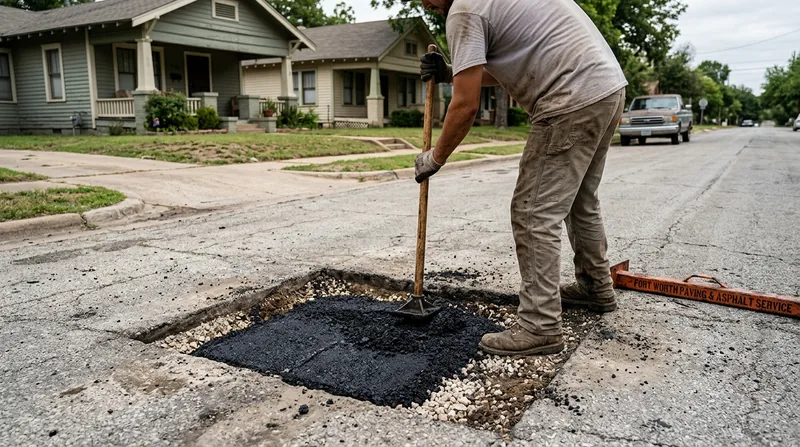




Pothole Repair & Asphalt Patching in Fort Worth requires understanding the specific geology and climate that create potholes here. Fort Worth sits on thin rocky clay over the Grand Prairie's limestone base, and where shallow limestone meets a thin clay pocket, water seeps in, freezes in winter, and pushes the asphalt up and out. Spring storms and summer heat cycles accelerate the breakdown. A pothole that starts small in March can double in size by May if left unpatched, and the longer it sits, the more base material washes away underneath. We cut a clean square patch, compact fresh base material, and seal it flush so summer heat does not push it back out. The work is straightforward, but the geology is not, and getting it right the first time saves money and frustration.
Why Potholes Form Faster in Fort Worth Than in Flatter Cities
Fort Worth's terrain and soil composition make pothole formation inevitable. The shallow limestone and caliche layer means that when water finds a crack in the asphalt, it does not have far to go before it hits the base. Freeze-thaw cycles, even mild ones, expand and contract that water, and the asphalt fractures. Summer temperatures above 100 degrees soften the asphalt edges, and traffic loads push the broken pieces down. The clay pockets that remain swell and shrink with rain and drought, working at the edges of a drive and opening cracks at the garage apron where the driveway meets the street. Hail and severe spring storms pock surfaces and accelerate the process. Once a pothole opens, the damage spreads fast because the base underneath is already compromised.
- Water enters through small cracks and sits on the base layer below the asphalt surface.
- Freeze-thaw cycles expand the water and crack the asphalt from underneath.
- Summer heat softens the weakened asphalt, and traffic loads break it into chunks.
- The base material washes away, and the hole grows larger with each rain and each vehicle pass.
- Patching early stops the spread and prevents a small repair from becoming a full resurfacing job.
Early patching is the most cost-effective response because it stops the water from reaching the base and prevents the hole from growing into the surrounding asphalt.
Fort Worth geology: Shallow limestone and caliche under thin clay means water reaches the base layer quickly. In Arlington Heights and Fairmount, narrow driveways on steep aprons collect water at the low edge, where potholes cluster. In master-planned subdivisions like those near Alliance and Benbrook, longer driveways with poor drainage develop potholes in the low spots first. Knowing where water sits on your drive tells you where the next pothole will form.
How We Patch Potholes in Fort Worth: A Step-by-Step Process
Pothole repair starts with a clean cut. We remove the broken asphalt and any loose base material, then compact fresh base to restore the load-bearing layer. The patch is sealed flush with the surrounding surface so water cannot pool at the edge. In Fort Worth's heat and clay, the quality of base compaction determines whether the patch holds or fails. A shallow patch over a soft base will re-fail under summer heat and traffic. We specify tonnage and compaction on every estimate so you know exactly what goes into the repair.
- We cut a clean square or rectangular perimeter around the damaged area to remove all broken asphalt and loose base.
- We excavate and remove any soft or water-logged base material down to stable ground.
- We compact new base material in layers, using a plate compactor or vibratory roller to achieve proper density.
- We place hot mix asphalt and trowel it flush with the surrounding surface, with no lip or depression.
- We allow the patch to cure before heavy traffic, typically 24 to 48 hours in warm weather.
The result is a patch that sheds water and holds under traffic because the base is solid and the asphalt is properly compacted.
Local example: A driveway in Benbrook with three potholes clustered at the low end of the apron typically needs all three patched at once, because water still collects there and will create new holes if drainage is not improved. We patch all three and may recommend grading the apron slightly to shed water faster, preventing repeat failures in the same spot.
For a more detailed look at how we approach driveway repair beyond potholes, see our driveway repair page. If the pothole is part of a larger pattern of cracking and failure across the drive, asphalt resurfacing may be the smarter investment.
| Approach | Description | Best for |
|---|---|---|
| Full-Depth Patch | Remove broken asphalt and all base material down to stable ground, replace with new compacted base and hot mix asphalt. | Potholes that have eaten through to soft or wet base, or holes larger than 2 feet in any direction. |
| Shallow Patch | Remove broken asphalt only, compact the existing base, and place new hot mix asphalt on top. | Small potholes in otherwise solid base, or surface breaks where the base is still intact. |
| Semi-Depth Patch | Remove broken asphalt and the top 2 to 4 inches of base, compact new base, and place hot mix asphalt. | Moderate potholes where the base is partly compromised but stable underneath. |
| Emergency Temporary Patch | Clean and fill with cold mix asphalt or temporary patching compound for immediate safety and traffic control. | Hazardous potholes that need immediate attention before a permanent repair can be scheduled. |
Pothole Repair & Asphalt Patching Cost in Fort Worth: What to Expect
Pothole repair in Fort Worth typically starts at $450 for a single small pothole with a clean base underneath. The cost moves up with the size of the hole, the depth of repair needed, and the condition of the base layer. A pothole that requires full-depth patching and base replacement costs more than one that only needs the asphalt surface replaced. Multiple potholes on the same driveway can be repaired more economically because we are on site once and can move between locations efficiently. Travel is included in our service area, and we provide a written estimate with tonnage and compaction specs so you know what you are paying for.
- A single shallow pothole with solid base underneath typically costs between $450 and $700 depending on size.
- Full-depth patches that require base replacement run from $700 to $1,200 per pothole.
- Multiple potholes on one visit cost less per hole because setup and travel are shared across the whole job.
- Extensive alligator cracking or pothole patterns across more than thirty percent of the surface usually indicate resurfacing is the better investment than patching.
See our pricing page for detailed cost ranges and factors that affect the final bill. Every estimate is free and includes a site visit so we can assess the base condition and give you an accurate number. Call us at (817) 529-9224 to schedule your estimate.
Pothole Repair & Asphalt Patching Near Me: What Fort Worth Homeowners Should Know Before Hiring
Choosing the right contractor for pothole repair means checking a few concrete details. We are fully insured and provide a written estimate with tonnage and compaction specifications so you can verify what you are paying for. Permitting requirements for driveway work vary by municipality in the Fort Worth area, so verify with your local building department whether your repair needs a permit. In master-planned communities, check your HOA rules to confirm that asphalt patching meets architectural standards. Get estimates from at least two contractors so you can compare the scope of work and the base preparation approach, not just the price. Be skeptical of contractors who offer a price over the phone without seeing the site, or who ask for a large cash deposit before the work starts.
- Verify that any contractor you hire carries liability insurance and can provide a certificate of insurance.
- Ask for a written estimate that includes the patch dimensions, base depth and compaction method, and asphalt tonnage.
- Check with the city or village where the work will happen to confirm whether a driveway permit is required.
- If your driveway is in an HOA community, confirm that the repair meets architectural guidelines before work starts.
- Request references from recent customers in Fort Worth or nearby areas and follow up with at least one.
- Avoid contractors who show up unsolicited at your door, offer a price without measuring, or request payment in cash before the work begins.
We are based locally in Fort Worth with local plates and a local address. We have been in business since 2010 and provide free estimates within 24 hours. Contact us at our contact page or call (817) 529-9224 to schedule your site visit.
Pothole Repair & Asphalt Patching in Fort Worth: Pricing Guide
| Service | Price | Details |
|---|---|---|
| Single pothole, shallow patch | Starting at $450 | Small pothole with solid base underneath, surface repair only, includes cleanup and site restoration |
| Single pothole, full-depth repair | Starting at $700 | Pothole requiring base layer replacement, compacted new base, hot mix asphalt, proper tonnage and compaction specs |
| Multiple potholes, same visit | Starting at $1,100 | Three to five potholes patched in one visit, economies of scale apply, travel included, written estimate with tonnage |
| Extensive damage or resurfacing | On estimate | Alligator cracking or pothole patterns covering more than thirty percent of surface, requires site assessment for accurate pricing |
| Travel | Included | No separate mileage fee within Fort Worth and surrounding service area, travel is part of the estimate |
| Estimate | Free | Written estimate within 24 hours, no obligation to book, tonnage and compaction method specified |
Indicative pricing, the exact cost depends on square footage, finish, and site access. Free personalized estimate within 24h at (817) 529-9224.


