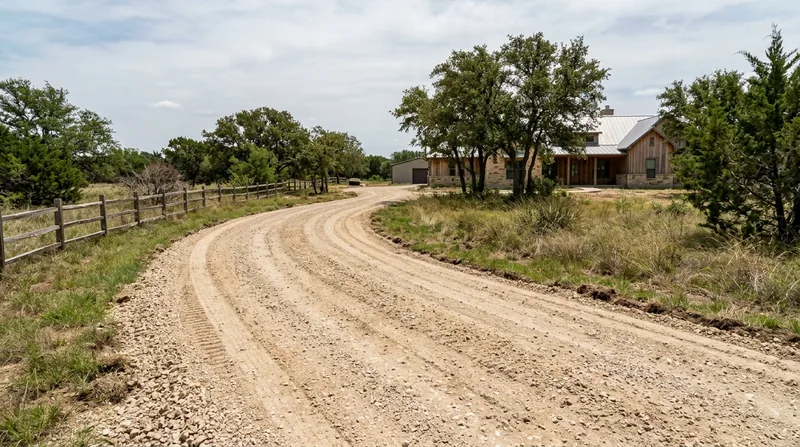




Gravel Driveway Installation & Grading in Fort Worth requires knowledge of the shallow limestone and caliche that lie beneath most of the city, plus an understanding of how Fort Worth's clay soils swell and shrink with seasonal rain and drought. A properly graded gravel drive crowns water away from structures, compacts to resist rutting under summer heat and traffic, and sits on a base that drains across the Grand Prairie terrain and the sandier Cross Timbers soils to the west. Whether you own a long rural property in Benbrook or Weatherford, a mid-century ranch in Arlington Heights, or a newer subdivision lot in North Richland Hills, gravel remains a practical and affordable entry point to driveway function. We grade, crown, and compact gravel bases that handle Fort Worth's climate and soil conditions, and we build them to last.
Why Gravel Driveway Grading Matters in Fort Worth: Drainage, Compaction, and Base Prep
Fort Worth sits on two distinct soil zones. The central and eastern portions rest on thin rocky clay over limestone, where excavation hits caliche and shallow rock before it reaches depth. The western and northern Cross Timbers soils are sandier and drain faster, but they also break down more quickly at the edges under vehicle traffic. In both cases, a gravel driveway that is not properly graded becomes a mud trap in spring, a washboard in summer, and a liability in winter. Grading means crowning the surface so water runs to the shoulders, compacting the base so it resists ruts and settling, and building drainage that works with Fort Worth's clay and limestone geology, not against it.
- We remove topsoil and organic matter to expose stable subgrade, then work around shallow limestone and caliche without over-excavating.
- We establish proper crown and slope so water sheds across the drive toward drainage outlets and away from your foundation or garage apron.
- We compact each gravel layer with a plate compactor or roller to create a stable, load-bearing base that resists rutting under vehicle weight and summer heat.
- We specify gravel size and tonnage for your soil type, so the base drains in clay pockets and holds together in sandy soils.
- We verify drainage patterns before final grading so water does not pool at low spots or flow toward structures.
Proper grading is the foundation of a gravel drive that holds up for years, not months. Without it, you end up patching and regrading every spring.
Key info: Fort Worth's limestone and caliche sit close to the surface across much of the city. We grade around these features rather than blasting through them, which saves cost and preserves your property. In Benbrook and Weatherford, where lots are larger and soils vary more, we adjust grading and compaction to match the terrain on your land.
For more on how to prepare a driveway base, see our guide to asphalt driveway paving and installation, which covers the full sequence from grading through final surface.
How We Grade and Install a Gravel Driveway in Fort Worth: Step-by-Step Process
Gravel driveway installation starts with a site visit to understand your soil, drainage, and the slope of your lot. We measure the drive, identify utilities using a Texas 811 locate, and plan grading around any limestone or caliche we encounter. From there, the work moves through removal, base prep, grading, compaction, and final topping. The entire process typically takes one to three days depending on drive length and site conditions.
- We call Texas 811 to locate underground utilities before any excavation begins, which is required by law and protects both you and us.
- We remove sod, topsoil, and organic material to expose the subgrade, working around shallow rock rather than through it.
- We grade the subgrade to establish proper crown and slope, sloping at roughly two to three percent so water runs off the sides.
- We add and compact the base gravel layer, typically four to six inches, using a plate compactor to achieve proper density and load-bearing capacity.
- We add a top dressing layer of smaller gravel or crushed stone, one to two inches, which binds to the base and provides a finished surface.
- We make a final pass with the compactor to seat the top layer and verify drainage across the entire drive.
The result is a gravel drive that sheds water, resists settling, and handles Fort Worth traffic and weather for years to come.
Local example: A 40-foot residential driveway in North Richland Hills on clay soil typically needs six inches of compacted base gravel plus two inches of top dressing. The job takes one day. A longer rural drive in Weatherford on sandier soil may need eight inches of base plus a two-inch top to resist edge breakage. We adjust the specification to the site.
For gravel maintenance and upkeep after installation, consult our page on recycled asphalt and millings driveways, which covers both new gravel installation and the use of recycled asphalt as a long-term base material.
Gravel Driveway Installation Methods and Materials
| Approach | Description | Best for |
|---|---|---|
| Crushed limestone gravel base | Local limestone, compacted in two layers, drains well on clay and binds over time to form a stable surface. | Fort Worth clay soils, central and eastern residential lots, foundation protection. |
| Recycled asphalt millings base | Recycled asphalt chips, compacted to create a hard, load-bearing base that hardens further under traffic and heat. | Long-term durability, rural properties, drives that see frequent use, cost-effective alternative to new asphalt. |
| Crushed granite or quarry rock | Larger angular stone, compacted for high load capacity and excellent drainage, does not bind like limestone. | Heavy traffic, steep terrain, sandy soils in western Fort Worth and Cross Timbers areas. |
| Pea gravel or marble chips top dressing | Smaller, rounded stone for a finished appearance, applied over a compacted base, does not compact or bind. | Aesthetic appeal, lighter-duty drives, properties where appearance matters, top layer only. |
We recommend a two-layer system: a compacted base of crushed limestone or recycled asphalt, topped with a one- to two-inch dressing of smaller stone. This approach balances durability, drainage, and cost for Fort Worth conditions.
Gravel Driveway Installation and Grading Cost in Fort Worth: What to Expect
Gravel driveway grading and installation in Fort Worth starts at $950 for a shorter residential drive on straightforward terrain. The final cost depends on drive length, width, the depth and type of base gravel needed, soil conditions, and whether utilities or rock require rerouting. A typical 40-foot residential driveway with six inches of compacted base plus two inches of top dressing runs $1,200 to $1,800. Longer rural drives, steeper slopes, or harder soils that require more aggressive grading push the cost higher.
Several factors move the price up or down. A drive on sandy Cross Timbers soil may need thicker base layers to resist edge breakage, adding cost. Shallow limestone or caliche that requires careful grading around (rather than through) the rock can add labor but saves blasting expense. A long drive up a hill in Weatherford or Benbrook incurs more grading and compaction work than a short flat lot in North Richland Hills. We measure the site, verify soil and drainage, and provide a written estimate with tonnage specifications so you know exactly what you are getting.
The best way to understand cost is to review our full pricing overview, which covers gravel installation across different drive sizes and soil types, and then request a free, no-obligation estimate for your property. We respond within 24 hours at (817) 529-9224.
Gravel Driveway Installation and Grading Near Me: What to Look for When Hiring a Contractor in Fort Worth
Hiring a gravel driveway contractor in Fort Worth requires the same care as hiring for asphalt or any site work. Start by verifying that any contractor you consider is fully insured, carries general liability and workers compensation, and can provide a current certificate on request. Ask for references from recent work in your neighborhood, and call them to confirm the quality and timeline. Get written estimates from at least two contractors, and make sure each estimate specifies drive dimensions, base depth, gravel type, tonnage, and compaction method. If you live in an HOA community, check your architectural guidelines before you proceed, as some developments restrict gravel to certain areas or require specific materials or colors.
- Request proof of insurance, including general liability and workers compensation, and verify it is current before work begins.
- Ask whether the contractor will call Texas 811 for a utility locate, which is required by law and is a sign of professional practice.
- Confirm that the estimate includes written tonnage specifications and a breakdown of base depth, material type, and top dressing.
- Check your local Fort Worth municipal code or your HOA rules to understand whether permits are required for driveway work in your area or community.
- Avoid contractors who offer a price without a site visit, demand a large cash deposit, or pressure you to decide on the spot.
A local contractor with Fort Worth plates, a local address, and verifiable references is your strongest signal of reliability. We have been in business since 2010 and operate from Fort Worth with a full-time crew. Contact us for a free estimate, and we will walk you through the process, answer your questions, and provide a clear, written proposal before any work begins.
Gravel Driveway Installation & Grading in Fort Worth: Pricing Guide
| Service | Price | Details |
|---|---|---|
| Short residential gravel drive (under 30 feet) | Starting at $950 | Includes site prep, four to six inch compacted base, top dressing, and final grading on straightforward terrain. |
| Standard residential driveway (30 to 50 feet) | Starting at $1,200 | Full grading, six inch base, two inch top dressing, compaction, and drainage on typical Fort Worth clay or mixed soil. |
| Longer or steep rural drive (50+ feet, sloped terrain) | Starting at $1,800 | Extended grading, thicker base layers, additional compaction passes, and rerouting around limestone or caliche as needed. |
| Complex site or sandy Cross Timbers soil | On estimate | Sites requiring deeper excavation, thicker base, difficult drainage, or multiple material types need an on-site assessment. |
| Travel and site visit | Included | No charge for travel within Fort Worth and surrounding service areas; estimate provided within 24 hours at no obligation. |
| Free estimate | Free | Written proposal with tonnage, dimensions, and material specifications; call (817) 529-9224 to schedule yours. |
Indicative pricing, the exact cost depends on square footage, finish, and site access. Free personalized estimate within 24h at (817) 529-9224.


