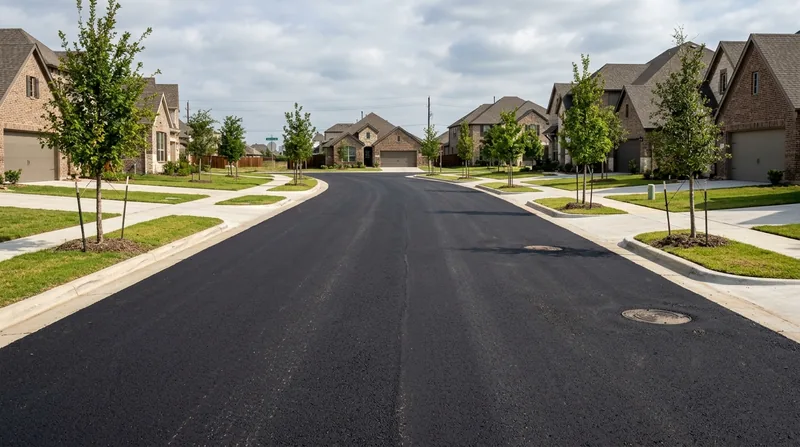




Private Road & HOA Paving in Fort Worth demands a base engineered for shallow limestone and clay, and a hot mix asphalt sized to handle the weight and weather of master-planned subdivisions. Fort Worth's private roads run from early master-planned communities near Benbrook and Alliance, where long driveways and wider lot frontages demand thicker, load-rated asphalt, to newer subdivisions pushing west and north where the Cross Timbers soils let edges break down faster under traffic. The clay pockets that swell and shrink with rain and drought work at the edges of a private road, opening cracks at intersections and under sustained heavy use. Summer heat above 100 degrees softens fresh asphalt if it is not compacted right, and spring hail and severe weather pock surfaces. We build the aggregate base and pave hot mix asphalt sized for HOA roads, with written estimates and tonnage specs so you know exactly what is going in the ground. Call us at (817) 529-9224 for a free estimate.
Why Private Road & HOA Paving Matters in Fort Worth's Master-Planned Communities
Private roads in Fort Worth subdivisions carry the same traffic as residential streets, but without municipal maintenance. A weak base or thin asphalt fails fast under repeated use, and by the time the surface cracks, the base underneath is often already gone. Fort Worth's shallow limestone and clay make base preparation critical: if the subgrade is not compacted and the aggregate base is not built to spec, an overlay will not hold, and you will be tearing it out in five years. HOA roads near Benbrook and Alliance handle everything from delivery trucks to resident cars, and the pavement must be rated for that load from day one.
- A proper aggregate base prevents edge failure and keeps the pavement from rutting under summer heat.
- Hot mix asphalt, poured and compacted to spec, gives you a surface that holds for 15 to 20 years with routine maintenance.
- Written estimates with tonnage and thickness mean you know what you are paying for and what the road will support.
- Permitting and HOA architectural approval are handled upfront so the job moves without delays.
A private road paved right costs less to maintain and lasts far longer than one built cheap.
Key info: Fort Worth subdivisions near Alliance and Benbrook often require HOA approval before any paving work begins. Check your HOA architectural guidelines and verify any permit requirements with your city or village before you call for an estimate. Texas 811 utility locates are required by law before any excavation, which base grading and new road construction both involve.
For more on the permitting process and what your HOA may require, visit the contact page to start a free estimate and ask about local requirements.
How We Build Private Roads & HOA Paving in Fort Worth
A private road starts with the subgrade. We grade, compact, and proof roll the soil to remove soft spots and settlement risk. Then we lay the aggregate base, sized for the expected traffic and the shallow rock and clay underneath. Finally, we pave hot mix asphalt, laid hot and compacted to density so it bonds properly and cures hard. Every step is documented with tonnage and thickness so you have a record of what went in and what the road will hold.
- We locate utilities with Texas 811 and mark the site to avoid damage and legal liability.
- We grade and compact the subgrade, removing soft clay and filling low spots so the base sits on solid ground.
- We lay and compact the aggregate base to the thickness required for the expected traffic load and local soil conditions.
- We proof roll the base with a heavy roller to find and fix soft spots before the asphalt goes down.
- We pave hot mix asphalt, laid and compacted to spec so it bonds to the base and cures hard.
- We document thickness, tonnage, and mix design on a written estimate so you have a record of the work.
This process takes longer than a quick pave, but it is the difference between a road that lasts 20 years and one that fails in five.
Local example: A private road in a North Richland Hills subdivision sits on clay that swells and shrinks with rain. We graded and compacted the subgrade, laid 6 inches of compacted base, and paved 3 inches of hot mix asphalt. The road handles delivery trucks, resident cars, and the seasonal movement of the clay underneath without cracking or rutting. The written estimate included tonnage and thickness so the HOA board knew exactly what was installed and what it would support.
For more detail on how we approach resurfacing and overlay work on existing roads, see our resurfacing page.
Private Road & HOA Paving Methods in Fort Worth
| Approach | Description | Best for |
|---|---|---|
| Full-Depth Replacement | Remove old asphalt and base, grade and compact subgrade, lay new aggregate base and hot mix asphalt to spec. | New private roads or roads where the base is failed and cannot be salvaged. |
| Mill and Overlay | Remove the top 1.5 to 2 inches of existing asphalt, pave new hot mix asphalt on the remaining base. | Roads where the base is sound but the surface is worn, cracked, or rutted from age and traffic. |
| Recycled Asphalt Millings | Lay recycled asphalt millings and compact with a roller; the material binds as traffic works it. | Private roads in rural or low-traffic HOA settings where budget is limited and traffic is light. |
| Tar and Chip | Spray a thin layer of liquid asphalt on the road, then top with stone chips and roll; creates a bound gravel surface. | Private roads with low to moderate traffic where a rural or rustic appearance fits the setting. |
Private Road & HOA Paving Cost in Fort Worth: What to Expect
Private road paving in Fort Worth starts at around $15,000 to $20,000 for a short lane or a single-access driveway apron, and scales up with length, width, and base condition. A full-depth replacement of a 300-foot private road 20 feet wide, on clay with shallow limestone, costs more because the base work is extensive. An overlay on an existing road with a sound base costs less because you are not removing and replacing the subgrade. The biggest cost driver is what is underneath: if the base is soft or the subgrade is clay that swells and shrinks, the base work is heavy. Access also matters. A road deep in a subdivision with tight turnarounds costs more to mobilize equipment than a road with open space and straight lines.
We provide written estimates with tonnage and thickness so you know what the cost covers and why. Get two or three estimates from local contractors, compare the aggregate base spec and asphalt thickness, and ask what happens if the subgrade is softer than expected. The cheapest estimate is often the one that cuts base thickness or skips proof rolling, and that is where roads fail early.
For a detailed breakdown of pricing and what moves the cost up or down, visit our full pricing page.
Private Road & HOA Paving Near Me: What Fort Worth Homeowners & HOA Boards Should Know
Hiring a paving contractor for a private road is not the same as hiring one for a driveway. The road is a shared asset, the HOA has rules about materials and standards, and the job is large enough that mistakes are expensive. Start by checking your HOA architectural guidelines and any deed restrictions on materials. Then verify whether your city or village requires a permit for the work. Some jurisdictions require a right-of-way permit even for private roads; others do not. Call your local building department and ask. When you get estimates, ask each contractor for references from other HOA roads they have paved in Fort Worth or nearby. Ask for tonnage and thickness on the estimate so you can compare apples to apples. Ask whether they pull permits or whether that is your responsibility. Ask what happens if the subgrade is softer than expected and the base gets thicker. A contractor who gives you straight answers and puts it in writing is one you can trust.
- Verify your HOA's architectural standards and any material or color requirements before you call for an estimate.
- Check with your city or village building department to confirm whether a permit is required for private road paving.
- Get written estimates from at least two contractors, with tonnage, thickness, and mix design on each one.
- Ask for references from other HOA roads or private roads the contractor has paved in the Fort Worth area.
- Understand that a road paved cheap will cost more to repair or replace in a few years than one built right the first time.
Ready to move forward? Contact us for a free estimate or call (817) 529-9224 to discuss your private road or HOA paving project.
Private Road & HOA Paving in Fort Worth: Pricing Guide
| Service | Price | Details |
|---|---|---|
| Private road or HOA lane (full-depth replacement) | Starting at $15,000 | Subgrade grading, compacted aggregate base, hot mix asphalt paved and compacted to spec with written tonnage and thickness documentation. |
| Mill and overlay on existing road | Starting at $8,000 | Remove top 1.5 to 2 inches of asphalt, pave new hot mix on existing base. Cost depends on road length and width and base condition. |
| Recycled asphalt millings or tar and chip | Starting at $3,500 | Lower-cost alternative for low-traffic private roads. Recycled millings or tar and chip surface with compaction. Suitable for rural or rustic subdivisions. |
| Complex or large-scale job | On estimate | Multi-phase paving, challenging soil conditions, or roads over 500 feet require site assessment to confirm tonnage and timeline. |
| Travel | Included | No separate travel fee or mileage charge for Fort Worth and surrounding areas within our service zone. |
| Estimate | Free | Written estimate with tonnage and thickness. Response within 24 hours at (817) 529-9224. No obligation to book. |
Indicative pricing, the exact cost depends on square footage, finish, and site access. Free personalized estimate within 24h at (817) 529-9224.


