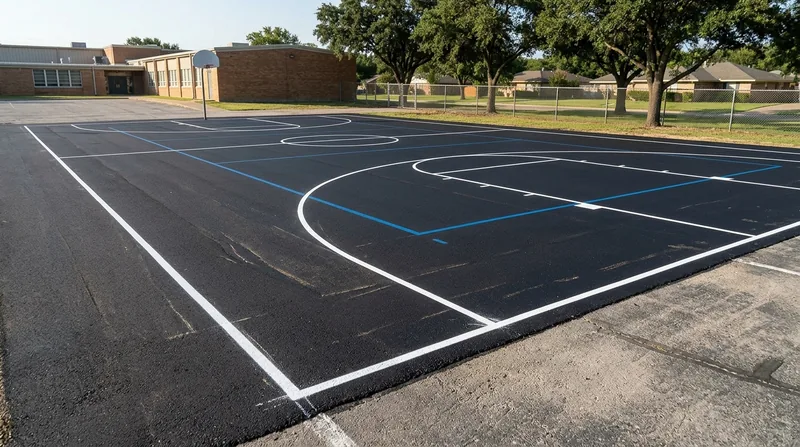




Sports Court & Path Paving in Fort Worth demands a foundation built to handle the specific pressures of this region: shallow limestone and clay that shift with Fort Worth's heat and rare winter storms, combined with the concentrated loads that basketball courts, tennis surfaces, and walking paths place on asphalt. Unlike a residential driveway, a sports court or recreational path must maintain dead-flat surface integrity across years of foot traffic, ball bounce, and equipment movement. We grade, compact, and pave these surfaces with the aggregate base and tack coat required to stand firm against Tarrant County's climate and soil movement, then stripe them to your specifications. Whether you're building a court in Fairmount, adding a path in Arlington Heights, or installing recreational surfaces in one of the newer master-planned subdivisions, the base preparation and surface finish determine whether the court plays true or fails in two seasons.
Why Sports Court & Path Paving Matters in Fort Worth
Fort Worth sits on thin rocky clay over limestone, with sandier Cross Timbers soils to the west and north. That combination means shallow rock and caliche appear quickly during excavation, and clay pockets swell and shrink with rain and drought cycles, opening cracks and edge failures. A poorly prepared base under a basketball court or tennis surface will develop settlement, alligator cracking, and soft spots within one or two seasons. Summer temperatures above 100 degrees soften fresh asphalt if it is not compacted correctly, and the rare winter ice storm stresses whatever was already weak. A properly graded and compacted base with tight tack coat application is the only way to build a court or path that stays playable.
- We excavate and remove unsuitable soils, then proof-roll the subgrade to confirm stability before any asphalt goes down.
- We place and compact aggregate base material in lifts, achieving the density required to resist clay movement and concentrated loads.
- We apply tack coat to bond the base to the asphalt, preventing slippage and edge raveling under foot traffic.
- We pave with hot mix asphalt, compact it tight, and finish with striping and line work to your court or path layout.
A court built this way will handle seasonal ground movement and the weight of players and equipment without premature failure.
Key info: Fort Worth's shallow limestone and clay movement are the primary drivers of court failure. A basketball court in Arlington Heights or a tennis surface in Benbrook must sit on a compacted base that anticipates that movement. We do not guess at base depth or density; we grade, measure, and compact to specification.
For more on how base preparation affects durability, see our Gravel Driveway Installation & Grading page, where the same principles apply to all asphalt surfaces.
How We Build Sports Courts and Paths in Fort Worth
The process begins with an on-site visit to measure the space, evaluate the soil and drainage, and understand your layout and striping needs. We then remove existing pavement if necessary, excavate to the required depth, and prepare the subgrade. The aggregate base is placed in compacted lifts, and the asphalt is laid and finished to a smooth, level surface. Striping, court markings, and line painting complete the job. This sequence is the same whether you're building a single-court installation or a multi-court complex with walking paths.
- We measure the court or path area and verify local code requirements for dimensions, setbacks, and drainage with the Fort Worth Building Department.
- We call Texas 811 for utility locates before any excavation, as required by law.
- We remove unsuitable soils and rock outcrops, then place and compact aggregate base in lifts to the specified density.
- We lay hot mix asphalt, compact it immediately while it is still hot, and finish the surface smooth and level.
- We stripe the court or path with thermoplastic or paint markings, sized and placed to your design.
The entire process takes two to five days depending on the size of the court or path and weather conditions.
Local example: A full-size basketball court in North Richland Hills, 5,000 square feet with a 6-inch compacted base and 2 inches of asphalt, takes three days from excavation to final striping. A walking path system in Hurst connecting two residential areas, 1,200 linear feet with a 4-inch base and 1.5 inches of asphalt, takes two days. Both are measured, quoted with tonnage and thickness specs, and completed on schedule.
Methods and Materials for Court and Path Paving
| Approach | Description | Best for |
|---|---|---|
| Full-depth asphalt court | Excavate unsuitable soil, place 4 to 6 inches of compacted aggregate base, lay 2 to 2.5 inches of hot mix asphalt, finish and stripe. | New courts, paths, and recreational surfaces where the base must handle clay movement and seasonal weather. |
| Overlay on existing asphalt | Mill or grind the existing surface if necessary to remove high spots, apply tack coat, then lay 1.5 to 2 inches of new asphalt and stripe. | Courts and paths with a sound base but worn or uneven surface, where full excavation is not necessary. |
| Grading and base only | Excavate and grade the site, place and compact aggregate base, proof-roll for verification, and leave ready for asphalt in a second phase. | Projects where asphalt paving is planned later, or where budget requires phasing the work. |
| Milling and re-paving | Mill the entire surface to remove failed asphalt and expose the base, repair or replace the base as needed, then lay new asphalt and stripe. | Courts and paths with alligator cracking or extensive surface failure where the base is sound but the surface is gone. |
Sports Court & Path Paving Cost in Fort Worth: What to Expect
A full-depth basketball or tennis court in Fort Worth starts at approximately $8,500 for a smaller installation, 2,500 square feet or less, with a compacted aggregate base and 2 inches of hot mix asphalt. The cost moves up with the size of the court, the depth of excavation required (shallow limestone and clay in Fort Worth often demand deeper base preparation), site access, and the complexity of striping or markings. A full-size competitive basketball court, 5,000 square feet, typically runs $12,000 to $16,000. Walking paths and recreational surfaces run lower per square foot but are quoted by linear footage and width. An on-site estimate is the only reliable way to establish cost, because base depth, soil conditions, and site prep vary significantly across Fort Worth's geography.
Factors that affect the final price include the size and shape of the court or path, the existing site condition (new land or removal of old pavement), the aggregate base depth required to handle Fort Worth's clay and limestone, site access and equipment staging, and any special markings or striping. We provide written estimates with tonnage and thickness specifications, so you know exactly what you are paying for. We recommend getting two or three estimates from local paving contractors to compare methods and pricing. See our Pricing page for a more detailed breakdown by service type.
Sports Court & Path Paving Near Me: What Fort Worth Homeowners and Property Managers Should Know
Hiring the right contractor for a court or path is as important as the surface itself. Before you book, verify that the contractor is fully insured and carries general liability and workers compensation coverage. Ask for references from recent court or path projects in your area, and call them to ask about surface quality, timeline, and whether the contractor followed through on maintenance advice. Understand your local permitting requirements: the Fort Worth Building Department may require a permit for court construction, particularly if the court is in the right-of-way or affects drainage. If you are in an HOA community, check the architectural guidelines before you start, because some master-planned subdivisions restrict the materials or placement of courts and paths. Request a written estimate that includes base depth, asphalt thickness, and tonnage; any contractor who cannot or will not provide those details is not worth hiring.
- Verify that the contractor has full insurance coverage and can provide a certificate of insurance before work begins.
- Ask for at least two references from similar court or path projects completed in the last two years.
- Check with the Fort Worth Building Department to determine whether a permit is required for your court or path.
- Review your HOA architectural standards if you are in a master-planned community, as some restrict driveway or court materials and placement.
- Get a written estimate that includes base depth, asphalt thickness, and tonnage, and compare at least two contractors before you decide.
- Avoid any contractor who solicits you door-to-door, offers a price that seems too good, or demands a large cash deposit upfront.
A reputable local contractor will answer questions about base preparation, drainage, and Fort Worth's specific soil and climate challenges, and will not pressure you into a quick decision. For a free estimate and honest guidance on your court or path project, contact us at (817) 529-9224. We serve Fort Worth, Arlington, Haltom City, North Richland Hills, Benbrook, Hurst, and surrounding areas, and we have been in the paving business since 2010.
See also our Asphalt Driveway Paving & Installation and Parking Lot Paving & Construction pages for related services and base preparation principles that apply to all asphalt surfaces.
Sports Court & Path Paving in Fort Worth: Pricing Guide
| Service | Price | Details |
|---|---|---|
| Small court or path (under 2,500 sq ft) | Starting at $8,500 | Compacted aggregate base and 2 inches asphalt, striping included, size and site excavation determine final cost |
| Full-size basketball or tennis court (5,000 sq ft) | Starting at $12,000 | Professional-grade base, 2 inch asphalt surface, full court markings, Fort Worth soil and limestone depth factored in |
| Walking paths and recreational trails (per linear foot) | Starting at $45 per foot | Width, base depth, and site access affect pricing; measured and quoted on site before work begins |
| Overlay or resurfacing existing court | Starting at $6,000 | Tack coat and 1.5 to 2 inches new asphalt on sound base; full excavation and base replacement cost more |
| Milling and removal | On estimate | Cost depends on surface area, depth of asphalt, and haul-away distance; quoted after site visit |
| Free estimate | No obligation | Written quote with tonnage and thickness specs within 24 hours, call (817) 529-9224 |
Indicative pricing, the exact cost depends on square footage, finish, and site access. Free personalized estimate within 24h at (817) 529-9224.


