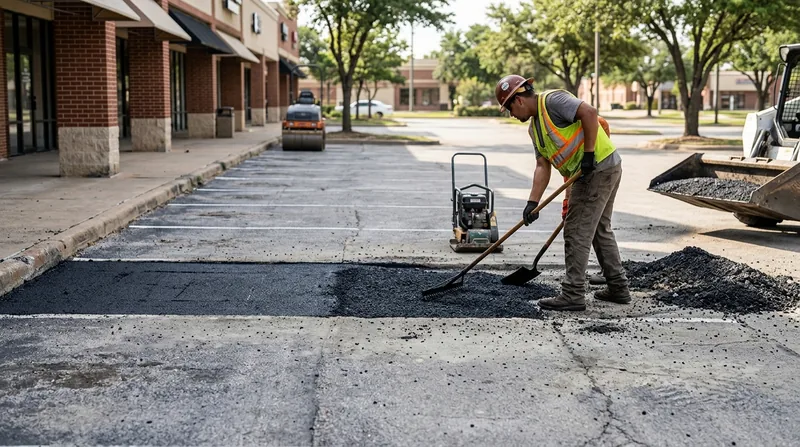




Parking Lot Repair & Resurfacing in Fort Worth requires a clear-eyed understanding of what fails and why. Fort Worth's parking lots sit on shallow clay and limestone, where summer heat above 100 degrees softens fresh asphalt, spring hail pocks the surface, and clay pockets shift under heavy traffic, opening cracks and rutting the wearing course. When patches fail and alligator cracking spreads across thirty to forty percent of the surface, the money belongs in resurfacing or full replacement, not throwing patches at a failing base. We cut out failed sections, rebuild the base properly, and resurface so the lot holds through the next drought, ice storm, or heat cycle. This page explains what we do, how we price it, and what to look for when hiring a contractor to get it right the first time.
Why Parking Lot Repair & Resurfacing Matters in Fort Worth's Climate
Fort Worth's parking lots fail in predictable patterns. The clay subgrade swells and shrinks with rainfall and drought, working at the edges of the lot and opening transverse cracks at the apron. Summer heat softens the binder in the wearing course, allowing rutting under the weight of parked and moving vehicles. Spring hail and severe weather pock the surface, and the rare winter ice storm stresses whatever was already weak. When you ignore small cracks and surface spalls, water infiltrates the base, the clay beneath destabilizes, and the entire section collapses into alligator cracking. At that point, patching is a waste of money.
- We identify whether the lot can be patched or needs resurfacing by measuring the extent of cracking and probing the base.
- We cut out failed sections cleanly, removing all unsound material and loose aggregate before we rebuild.
- We install a proper aggregate base, compact it to density, and tack the new asphalt so it bonds and holds.
- We patch flush so water sheds off instead of pooling, and the lot drains the way it should.
Proper repair stops the spread of failure and protects your investment through the next cycle of Texas heat and weather.
Key info: Fort Worth's Building Services department and your HOA (if applicable) set the rules for lot repairs, curb cuts, and stormwater compliance. Before we start, verify permit requirements with your municipality. We help navigate the permitting process, but the responsibility lies with you and your city.
For more on how we handle repairs across similar surfaces, see our Driveway Repair and Pothole Repair & Asphalt Patching pages.
How We Repair and Resurface Parking Lots in Fort Worth
Every parking lot repair follows the same principle: remove the failed material, rebuild the base, and install new asphalt that bonds and compacts properly. The difference between a patch that lasts and one that fails within two seasons is the work you don't see: base preparation, tack coat, and compaction. We follow this sequence on every job, whether it's a small pothole or a full resurfacing of a 10,000-square-foot lot.
- We measure the lot, identify failed sections, and probe the base to confirm whether patching or resurfacing is the right call.
- We cut out all unsound material using proper milling or saw-cutting, removing the failed asphalt and any soft or displaced base.
- We grade the excavated section, install new crushed limestone or recycled asphalt base, and compact to proper density.
- We apply a tack coat (asphalt emulsion) so the new asphalt bonds chemically to the base and the surrounding pavement.
- We place and compact new hot mix asphalt at the correct temperature and thickness, sloped for drainage.
- We finish the edges flush and clean, so water sheds away and the lot functions properly.
The result is a repair that holds because the base is right and the bond is solid.
Real example: A retail lot in Arlington with 40 percent alligator cracking and settled clay beneath the failed sections needed resurfacing, not patching. We milled the top two inches, rebuilt the base with compacted recycled asphalt, and installed a new wearing course. The lot now sheds water correctly and will hold for 12 to 15 years with normal maintenance. Patching would have failed within 18 months.
For larger projects requiring complete reconstruction, see Parking Lot Paving & Construction.
| Approach | Description | Best for |
|---|---|---|
| Pothole and full-depth patch | Remove failed section to base, rebuild base, tack and compact new asphalt flush to surrounding pavement. | Isolated failures, soft spots, edge breaks affecting less than five percent of the lot. |
| Overlay (asphalt resurfacing) | Mill or grind the top layer, tack the existing base, and place new wearing course over sound pavement. | Lots with surface cracking and minor base settlement, but the base is still competent and well-drained. |
| Mill and patch combination | Mill failed sections selectively, rebuild base where needed, patch with new asphalt, then overlay the entire lot. | Lots with scattered deep failures and widespread surface cracking affecting 20 to 35 percent of area. |
| Full-depth replacement | Excavate failed asphalt and base, rebuild the entire section from subgrade up with proper base and new wearing course. | Lots with failed base, standing water, or alligator cracking covering more than 40 percent of the surface. |
Parking Lot Repair & Resurfacing Cost in Fort Worth: What to Expect
Parking lot repair pricing depends on the extent of failure, the base condition, access for equipment, and whether the lot needs patching or full resurfacing. A small pothole patch runs from $650 to $1,200. A section resurfacing (500 to 1,000 square feet) runs from $1,500 to $3,500. A full lot resurfacing of 5,000 to 10,000 square feet runs from $8,000 to $18,000 or more, depending on base work and site conditions. These figures are starting points; the only way to know your actual cost is a free on-site estimate.
Several factors move the price up or down. If the base is sound and we're only patching isolated spots, the cost stays low. If the base is soft or settled, we rebuild it with compacted crushed limestone or recycled asphalt, and the cost rises. If the lot has poor drainage or standing water, we may need to regrade and install or improve drainage swales, which adds labor and material. If the lot is in an HOA or a municipality with strict permitting, we help navigate that process, but delays and compliance costs are yours to manage.
The smartest move is to get two or three written estimates with tonnage and thickness spelled out. That's how you compare apples to apples and avoid the contractor who quotes a price without seeing the job or specifying what goes into it. For a detailed pricing breakdown across all our services, visit our pricing page.
What to Look for When Hiring an Asphalt Paving Contractor Near Fort Worth
The parking lot paving industry has a long history of door-to-door crews, unsolicited offers, and scams built on pressure and cash deposits. Protect yourself by following a few simple rules. First, never hire a contractor based on an unsolicited offer or a price quoted over the phone without a site visit. Second, verify that any contractor you hire is fully insured and can provide a current certificate of insurance before work starts. Third, get a written estimate that spells out the scope, materials, thickness, tonnage, and timeline. Fourth, check references and ask to see recent work in your area. Fifth, verify permit requirements with your city or HOA before signing, and confirm that the contractor understands local rules.
- Ask whether your city or HOA requires a permit for parking lot repairs, and confirm the contractor will help you navigate that.
- Verify that the estimate includes the base work, not just the asphalt, and that thickness and tonnage are specified in writing.
- Request references from three to five jobs completed in Fort Worth or nearby in the last 12 months.
- Confirm that the contractor is fully insured with general liability and workers' compensation, and ask for a current certificate.
- Never pay a large cash deposit upfront; a reasonable deposit is 25 to 33 percent, with the balance due on completion.
- Avoid contractors with out-of-state plates, no local address, or a price that sounds too good to be true.
Honest guidance and a clear written contract are the marks of a contractor worth hiring. For a free estimate with no obligation, contact us at (817) 529-9224 or fill out our online form. We've been in business in Fort Worth since 2010, and we stand behind every job with a warranty on workmanship.
Parking Lot Repair & Resurfacing in Fort Worth: Pricing Guide
| Service | Price | Details |
|---|---|---|
| Pothole and spot patch | Starting at $650 | Single or multiple isolated failures, full-depth removal and base rebuild, tack and compact, typically 50 to 200 square feet |
| Partial lot resurfacing | Starting at $1,500 | 500 to 1,000 square feet of milling, base repair, and overlay, includes tack coat and compaction to proper density |
| Full lot resurfacing | Starting at $8,000 | 5,000 to 10,000 square feet, milling or selective full-depth patches, new base where needed, complete overlay, sloped for drainage |
| Full-depth reconstruction | On estimate | Excavation, subgrade prep, base installation, and new wearing course required when base has failed or lot drains poorly |
| Free estimate | No charge | On-site measurement, base assessment, and written scope with tonnage and thickness, response within 24 hours at (817) 529-9224 |
Indicative pricing, the exact cost depends on square footage, finish, and site access. Free personalized estimate within 24h at (817) 529-9224.


