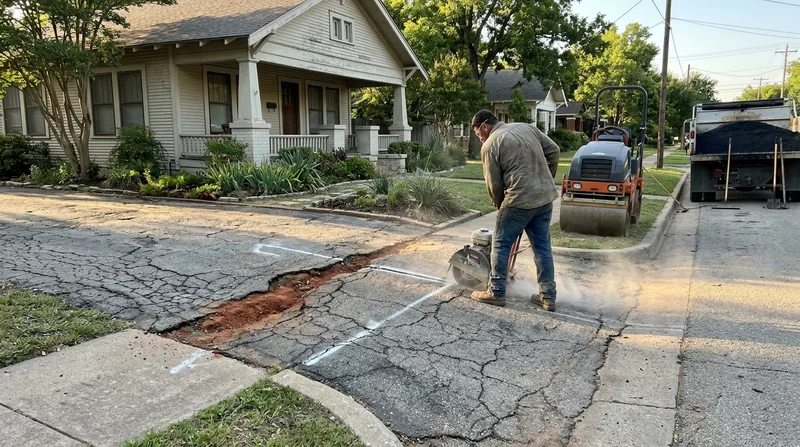




Driveway Repair in Fort Worth means cutting out the failed asphalt, patching down to solid base, and sealing the edge so it holds through the next drought or ice storm. Fort Worth's driveways crack along the edges where clay pockets swell and shrink with the weather, and the shallow limestone underneath makes proper base preparation critical. Whether you own a narrow in-town bungalow in Fairmount with a steep apron, a mid-century ranch on a wider lot, or a newer home in a master-planned subdivision with a three-car drive, edge cracking and pothole damage are the signature failure mode in Tarrant County. We remove the damaged asphalt, build back to solid base, and seal the repair so it doesn't reopen when the temperature swings or rain returns. The difference between a patch that holds and one that fails again in two years is the base work and the edge seal, and that's where we focus.
Why Driveway Repair Matters in Fort Worth's Clay and Rock
Fort Worth sits on thin rocky clay over the Grand Prairie's limestone, and that geology drives the failure pattern. When rain soaks the clay around your driveway edge, it swells. In summer heat and drought, it shrinks and pulls away from the asphalt. That cycle opens cracks, and once water gets underneath, the base breaks down and the asphalt sags or pops out. Hail in spring and the rare winter ice storm accelerate the damage. A patch that cuts out the failed section and seals the edge stops that cycle before it spreads across the whole drive.
- We identify whether the damage is confined to edges or has spread into the field of the driveway.
- We cut out all failed asphalt and probe the base to confirm it is solid and properly compacted.
- We remove any soft material and add new base if the subgrade has failed.
- We install new asphalt and seal the edge with a flexible material that moves with the clay.
- We compact the new patch to the same density as the surrounding drive so it doesn't rut or settle.
The result is a repair that lasts because it addresses the root cause, not just the surface symptom.
Key info: Fort Worth's clay-swell failure is most visible in spring after wet winters, and again in late summer after extended heat. A repair done in fall or early winter, when the clay is stable, holds better than one done in the middle of a wet or drought cycle. If you see edge cracks opening in March or April, repair now before the summer heat softens fresh asphalt.
For more detail on the full range of repair options, see our guide to Pothole Repair and Asphalt Patching.
Check with your city on permit requirements before you start. Fort Worth Building Services can tell you whether an apron repair requires a permit in your jurisdiction.
How We Handle Driveway Repair in Fort Worth
A proper repair starts with understanding what failed and why. We measure the damage, probe the base, and decide whether a patch is the right answer or whether the driveway needs resurfacing or replacement. If patching is the call, we cut clean edges, remove all failed material, prepare the base, and install new asphalt with the right compaction and edge seal. The whole job usually takes a day, and you can drive on it within 24 to 48 hours depending on temperature.
- We visit your driveway to measure the damaged area and test the base underneath.
- We cut out all failed asphalt with clean, straight edges so the patch bonds properly.
- We inspect and repair the base if it is soft, and add new compacted base if needed.
- We tack the edges of the existing asphalt so the new patch bonds and does not separate.
- We install new hot-mix asphalt, compact it to specification, and seal the edge.
- We confirm the patch is level with the surrounding surface and drains properly.
The repair holds because we do the base work first, not because we use a magic material or a warranty.
Example: A home in Arlington with edge cracking along both sides of a 20-by-30-foot drive. We cut out about 40 linear feet of failed asphalt, found soft clay underneath, replaced it with compacted base, and patched with new asphalt and edge seal. Cost ran $1,200 to $1,500 depending on base depth. The drive has held for three years without reopening because the base was solid and the edge was sealed.
If your driveway has extensive alligator cracking across more than 30 or 40 percent of the surface, patching is not the answer. See our page on Asphalt Resurfacing and Overlay to understand when a full surface treatment makes more sense than patching.
Driveway Repair Methods and When to Use Each
| Approach | Description | Best for |
|---|---|---|
| Edge patching | Cut and remove failed asphalt along the edge, repair or replace base, install new asphalt and seal the edge with flexible material. | Cracks and damage confined to the first 12 to 18 inches from the edge, solid base underneath. |
| Full-depth pothole patch | Remove all asphalt down to subgrade, inspect and repair base, compact new base, install new asphalt and tack the edges. | Potholes and localized failures in the field of the drive where the base has broken down. |
| Multiple patches | Repair several separate damaged areas in one visit, each cut clean and patched to the same standard as a single repair. | Driveways with scattered damage on different sections, but less than 30 percent of the surface failed. |
| Overlay or resurfacing | Mill the top layer of asphalt, inspect the base, and install a new 1.5- to 2-inch layer of hot-mix asphalt over the whole drive. | Driveways with alligator cracking covering 30 to 60 percent of the surface, solid base, and five to ten years of remaining life expected. |
Driveway Repair Cost in Fort Worth: What to Expect
A typical edge patch on a Fort Worth driveway starts at around $450 to $600 and covers 40 to 80 linear feet of cracked edge with proper base repair and edge seal. A full-depth pothole repair in the field of the drive runs $500 to $1,200 depending on the size of the hole and the depth of base repair needed. Multiple patches on the same driveway cost less per patch than a single isolated repair because we are already on site and mobilized. If more than 30 or 40 percent of your driveway is damaged, resurfacing the whole drive is usually a better value than patching, because you avoid the cost of multiple repairs over the next few years.
The cost of a repair depends on the size of the damaged area, the condition of the base underneath, how much base material needs to be replaced, and whether the edge can be sealed or needs to be rebuilt. A narrow edge crack in a home in Benbrook with stable clay underneath costs less than a wide pothole in Hurst where the base has failed completely. We measure on site and give you a written estimate before we start work. Get two or three estimates from contractors you trust so you can compare the scope and the price.
For a full breakdown of pricing across all our services, see our pricing overview.
Driveway Repair Near Me: What Fort Worth Homeowners Should Know When Hiring a Contractor
The strongest sign of a trustworthy paving contractor is that they are verifiably local with a local address and local plates, because the historic fraud in driveway paving is the door-to-door crew with out-of-state plates offering to use "leftover asphalt from a job nearby." A real contractor has a history in your city, references you can call, and a written contract that spells out the scope, the materials, the timeline, and the price before work starts. Ask for a written estimate that includes the linear feet or square feet being repaired, the thickness of the asphalt, the tonnage of material if it is a larger job, and the base repair plan. If a contractor will not give you those details in writing, that is a red flag.
Verify that any contractor you hire carries liability insurance and can provide a certificate on request. Confirm whether your city or your HOA requires a permit for the repair. Some Fort Worth neighborhoods and master-planned communities have architectural standards or right-of-way rules that govern driveway work, and your HOA or city can tell you what applies to your property. Ask the contractor to walk you through the repair process so you understand what the work entails and why it costs what it does. A contractor who takes time to explain the base condition and the edge seal is one who understands the work.
Call us for a free estimate at (817) 529-9224, or request an estimate online and we will respond within 24 hours. We serve Fort Worth, Arlington, Benbrook, Hurst, Keller, and the surrounding areas, and we have been in business since 2010.
Driveway Repair in Fort Worth: Pricing Guide
| Service | Price | Details |
|---|---|---|
| Edge patch repair | Starting at $450 | 40 to 80 linear feet of cracked edge, base repair, and flexible edge seal included in this price range |
| Full-depth pothole repair | Starting at $500 | Single pothole or localized failure with full base inspection and replacement if needed; cost rises with pothole size |
| Multiple patches on same driveway | Starting at $800 | Two to four separate repairs completed in one visit; per-patch cost is lower than isolated repairs because mobilization is shared |
| Extensive base repair or large patch | On estimate | Repairs requiring significant base replacement, multiple patches, or base failure across a large area need on-site inspection first |
| Travel and estimate | Included | No separate mileage fee or travel charge in Fort Worth and surrounding service areas; free written estimate within 24 hours |
Indicative pricing, the exact cost depends on square footage, finish, and site access. Free personalized estimate within 24h at (817) 529-9224.


